
Ocean Polymetallic Nodules are Essential for Sustained Technological Development on Earth
My series, The Rise of Oceania, takes place in the 2130s as people are settling and working the ocean floors. On the surface, countries are dealing with rapid climate change, including drought, famine, rising waters, flooding, interrupted shipping, refugee crises, wars, and dictatorships. Nations have decided to expand their reach to the oceans to extract valuable and much-needed resources like fish, crops (kelp), and minerals. This colonization has triggered a cold war, full of espionage, spycraft, and outright fighting. It is a rich and exciting setting for me to write my TechnoThrillers. But what type of minerals do the oceans offer us? Where are they located, and what are their values? Could their locations and existence really cause global conflict? And shouldn’t we be looking to outer space, the Moon, asteroids, and comets instead?
Introduction
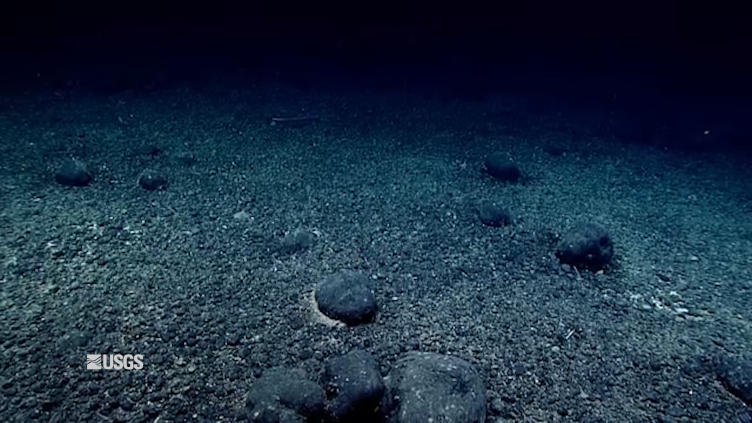
The ocean floors are immense. They are twice the size, in area, of Mars. They are located right off our shorelines, within easy reach. Countries already have Exclusive Economic Zones (EEZ), stretching 200 nautical miles from shore. But farther out, in international waters, the deep ocean abyssal plains include vast areas of mineral wealth. The technology to reach the floors already exists. And the minerals — found in nodules, or gravel and potato-sized rocks — are lying on the seafloor. No digging needed.
Now compare with asteroids or the Moon. Extraction vessels would have to first reach orbit. Immense masses of equipment, people, and the resources needed to sustain them would have to travel to the mineral location far out in space. Fuel would be needed to propel them there. The enormous distances would take months (or years) to traverse. The inhabitants of the vessels would need all the resources to sustain them for the journey. Then the ore would have to be extracted, refined, and shipped back. Then the workers would also have to return. An endeavour such as this would take an amount of money that would make the resources worthless … meaning, there would be a net loss of investment, rendering the ore simply useless rock. Companies would go bankrupt in the attempt.
By definition, a resource is something that has value to humans. It is something that is needed. A great example is Uranium. Before the 1940s, this metal was not considered a useful resource. After 1945, however, it become extremely valuable.

‘Ore,’ on the other hand, is rock containing a mineral that can be extracted for less than the company spends to get it. In other words, a company or individual can profit from the material, or, they can earn more than they spend extracting it. On Earth, most ore resources would be located near major roads, railways, or sealanes, and therefore are within easy reach for shipping. Remote outposts, in the Northern Arctic, for example, would have to have ores of an extremely high value to justify extracting them and shipping them back to market.
But the oceans offer a wealth of resources that are within easy reach. I have frequently written about such resources here at Life After Gateway. These include fish, kelp, and minerals. I have spoken about our need for such resources in interviews, here and here. Today, let’s look at Polymetallic Nodules, often called Manganese Nodules. They are rich in Manganese (hence the term), but also in Cobalt, Titanium, Nickel, and Copper. And, also some extremely rare but highly-valued minerals crucial for today’s technology. More on that soon …
Background and Formation
Metal compounds dissolved in ocean water precipitate around a nucleus or particle on the sea floor. This “nucleus” could be a pebble, a bit of shell, or even a shark’s tooth. Compounds of other metals then also begin to join the mass. The amount of minerals lying on the seafloor in this type of deposit, just waiting to be “scooped up,” is astonishing.
Areas around tectonically-active seafloor zones are especially rich in nodules. Vents releasing mineral-rich fluids contribute to their growth:
(video from Woods Hole Oceanographic Institute)
The following graph illustrates the amount of mineral just in the Clarion-Clipperton Zone, in the Eastern Pacific. Note Manganese, at 5992 million tonnes. On the surface, in global reserves including both economically recoverable and sub-economically recoverable, are 5200 million tonnes. This means there is more manganese in this one area in the Pacific Ocean than currently on land!

Graph by TSJ; data from World Ocean Review
The nodules range from the size of gravel to that of heads of lettuce. Most are the size of potatoes. The growth rate, depending on the method of formation, ranges from ten millimetres to 100 millimetres per million years. To accumulate, the nodules require good oxygen supply and a constant flow of Antarctic “bottom” water, which is the flow of water from the cold south pole toward northerly regions. Regions near tectonic activity, including sulfide vents, contribute Copper, Zinc, Lead, Gold, and Silver.

Locations
Polymetallic nodules exist in every ocean. The concentration/size must be such that companies can make a profit after extraction. Currently, there are four major regions where this might happen: the Indian Ocean, and three areas in the Pacific. The depths and pressures must be overcome in order to extract them, although robotic or remote-controlled equipment can be used. As the supplies on land of these metals decrease, and the price of the metals increase, more areas will open up for us in the world’s oceans. It might cost more to extract from the seafloors, but if prices are very high for consumers, more areas will soon be economically viable.
Consider Copper, which is becoming more rare on land. The United States is a major producer of world Copper (the fifth largest, in fact), however much is also imported to the States from Chile. That being said, Chile’s production has decreased by 30% since 2005, while Chinese production is increasing. This makes the US more reliant on China for Copper, which geopolitically is not a positive for the United States. Supplies on land are dwindling, and consider this: a single tonne of copper is used for 40 cars, 100,000 cell phones, 400 computers, and brings electricity to 30 homes. This means that the “copper squeeze,” geopolitically speaking, could be more important than oil. In short, the US requires larger supplies of Copper to reduce a need from other locations, like China. Ocean nodules can be a major source of Copper.
Here are the main locations of nodules. There are four of them pictured. Note that even though these four areas are the main regions, nodules are found in every area of the ocean, and there are many nodule-rich zones that may remain undiscovered. In my book series, The Rise of Oceania, there is a hypothetical region that the superpowers are waging war over: The Iron Plains, located west of Hawaii.
(The green areas are “Exclusive Economic Zones,” the 200 nautical mile zone prescribed by the International Law of the Sea, in which all ocean resources, including those on the ocean floors, are owned/managed by the adjacent countries.)

from World Ocean Review
In areas outside of the EEZs, the minerals are regulated by the International Seabed Authority. The ISA has awarded minimal licenses so far. Most are for exploration purposes and are for fifteen-year periods. In future years, more and more licenses will be granted, as minerals grow scarce on land, such as Copper. At the ISA, the current (and expired) licenses can be viewed here.
Estimated Values
Polymetallic nodules are commonly called “Manganese Nodules,” because of the high proportion of Manganese. However, there are usually multiple minerals in each nodule. In the CCZ, for instance, nodules contain mostly Manganese, Nickel, Copper, and Cobalt. The estimated amount of nodules are 500 billion tonnes, but some estimates are much higher than this. Deep Sea Mining estimates the value at $233,000,000,000,000 (that’s 233 trillion dollars)!
Rare Earths
But wait — there’s more. I’ve only touched on some of the more abundant minerals, like Copper. There are also “Rare Earths” to discuss — minerals that are needed for modern technology, and currently the largest producer/refiner is China. These are also common in polymetallic nodules, especially in the Clarion Clipperton Zone. They might also exist in other locations in the deep ocean abyssal plains; no one really knows until there is more investment into research and exploration. The minerals in this category are used for touch screens, rechargeable batteries, nuclear reactors, MRIs, magnets, light bulbs, and other vital electronics.
These minerals include:
- Neodymium
- Neodymium
- Lanthanum
- Dysprosium
- Thulium
- Terbium
- Praseodymium
- Cerium
- Holmium
- Gadolinium
- Europium
- Ytterbium

The F-35 uses more than 900 pounds of rare earths in each airplane! These are located in its radars, the motors that move its rudders, and in crucial electronic warfare systems, along with other sensitive (and secret) electronics.
The importance of polymetallic nodules in the oceans cannot be overstated, especially when China is currently the dominant country in terms of extraction and refining.
Harvest / Extraction Methods
There were some collection studies in the late 1970s and 1980s. Since the nodules are about the size of potatoes, it makes sense that harvesting would be similar to potato harvesters on the surface. This method worked. The machine would roll across the seafloor, and since the nodules are lying on top and not usually deep below sediment (although sometimes are covered by a thin layer), the machine would churn the nodules and load them into a cargo hold within the vessel.
Here is a proposed machine, from World Ocean Review:

I designed a harvester for my book, A Blanket of Steel. It was called The Roach, and is pictured here.

Theoretically, it would be negatively buoyant and would drive over the ocean floor, “scooping” nodules into its belly for later processing at a different location. In A Blanket of Steel, there is a great deal of action, including hand-to-hand combat, within The Roach.
Conclusion
The oceans are immense and the values of their resources are incomprehensible. As populations on land continue to explode, as global warming, famine, drought, and rising waters continue on the surface, our need for resources will escalate. The human race is insatiable, you could say, and we must keep up with demand or we will suffer from rebellion, dictatorship, death, disease, and war for essential resources. Polymetallic Nodules on the ocean floor are plentiful and the ability to harvest them currently exists. We need to look at expanding our exploitation of nodules in order to satisfy human industrial and technological requirements. Outer space, asteroids, the Moon, and Mars are not currently viable options for us.
The oceans are our future, and that’s why I wrote the series, The Rise of Oceania.
— Timothy S. Johnston, 6 May 2025
For Further Reading
Mineral Resources from World Ocean Review
Manganese Nodule, from ScienceDirect
Deep-sea Mining Interests in the Clarion-Clipperton Zone, from Ocean Exploration
Minerals: Polymetallic Nodules, from the International Seabed Authority
US Vulnerable to Future Copper Supply Squeeze, from Geopolitical Monitor
How Polymetallic Nodules Form, from Deep Sea Mining
Manufacturer’s Case Study: Using the Rare Earth Elements
———
Praise for Timothy S. Johnston’s A Blanket of Steel
“Fans of Clive Cussler’s NUMA Files will be delighted with Timothy S. Johnston’s undersea novels. Truman McClusky and Dirk Pitt are cut from the same adventurer’s cloth.” — Nick Cutter, author of The Deep and The Troop
“Action that ranges from close range combat to torpedo-fueled attacks. The result is a thriller that keeps moving from confrontation to confrontation … with constant danger and the vast depths of the ocean as a setting, there is always reason to keep reading.” — Kirkus Reviews
“Read the book and prepare to be blown away by one of the best writers I have ever had the pleasure to read. Timothy S. Johnston is simply amazing.” — FIVE Stars from Readers’ Favorite
“A Blanket of Steel is not simply a ‘daring do’ thriller … It’s prescient.” — Amazing Stories
“A priority selection. An action-packed story that is hard to put down. A Blanket of Steel is outstanding.” — D. Donovan, Sr. Reviewer, Midwest Book Review
“Innovative technology, Mac taking risks no one else would dare and thinking his way through to brilliant solutions … But the stakes are higher than they’ve ever been before. This is it. The countdown to the final battle … Johnston does an excellent job of keeping the tension taut as he plays with the reader’s perceptions of characters we thought we knew and trusted …” — SFcrowsnest
“Expect to be left breathless. Trust me here. Please. I COULD NOT PUT IT DOWN.” — Michael Libling, author of The Serial Killer’s Son Takes A Wife and Hollywood North: A Novel in Six Reels
———
A BLANKET OF STEEL is out now!
WATCH THE GRIPPING BOOK TRAILER HERE.
FOR PURCHASE OPTIONS CLICK HERE
———
A Blanket of Steel from Timothy S. Johnston and Fitzhenry & Whiteside, Ltd.
Book Cover & Jacket Copy:
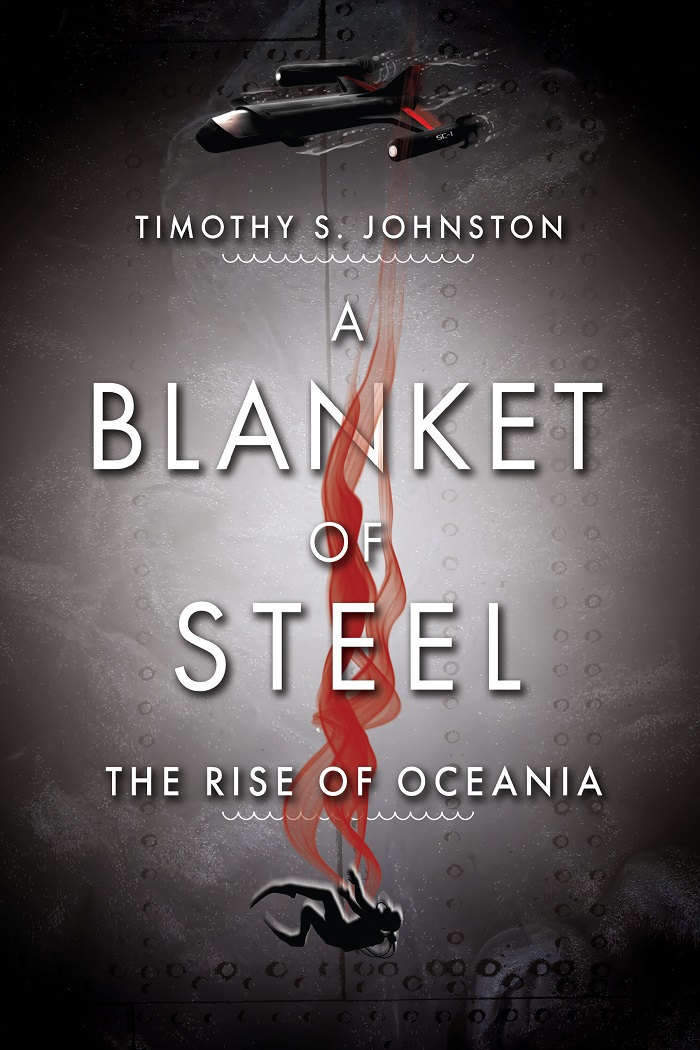
AN UNSTOPPABLE THREAT!
A mysterious assassin has murdered Cliff Sim, Chief Security Officer of the underwater colony, Trieste. Cliff was a mountain of a man, highly trained, and impossible to defeat in combat. And yet …
Someone brutally beat him and left his broken body in a secret Chinese facility at the bottom of the Pacific Ocean.
And included a calling card for Truman McClusky, Mayor of Trieste.
Taunting him.
Mac has led the underwater colonies in their fight against the world’s superpowers. Climate change has devastated the surface; nations suffer famine, drought, rebellion, rising waters, and apocalyptic coastal flooding. But now, as Mac leads the underwater colonies to freedom and independence, he’s faced with the gravest threat of his life: a Russian assassin, hellbent on killing Mac and everyone he cares for. Now Mac must uncover the identity of the killer, face him in combat, and at the same time lead people in battle against the largest underwater force ever assembled. It’s Mac’s final test, and to win the war, he must use every tool at his disposal, including the most surprising and devastating underwater weapons ever invented.
If Mac fails, all hope is lost for the future of human colonization on the ocean floors.
But the assassin could be anyone …
Watch your back, Mac.
A Blanket of Steel is the most gripping thriller yet in The Rise of Oceania.
FOR PURCHASE OPTIONS CLICK HERE
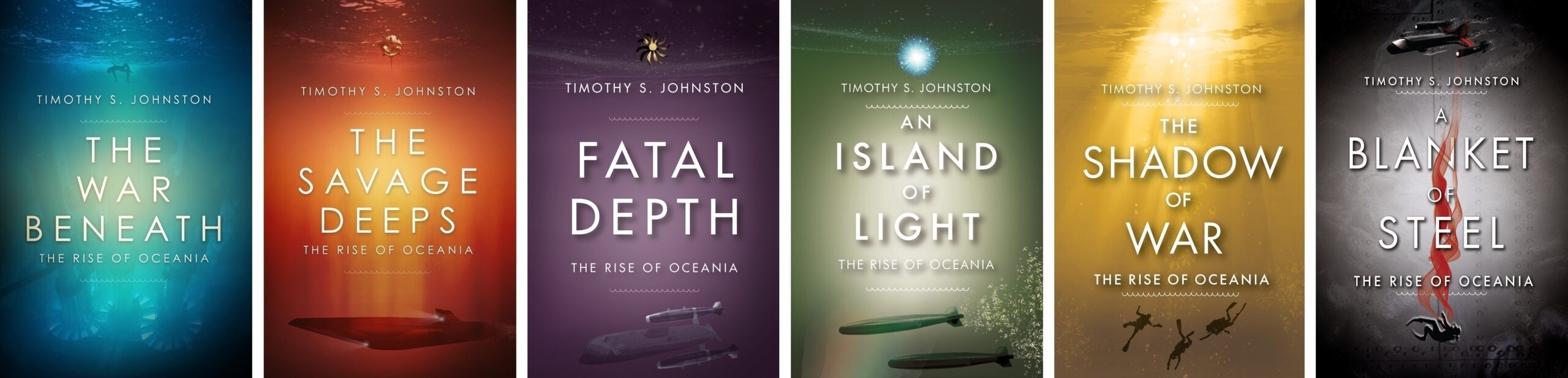
The other books in The Rise of Oceania series by Timothy S Johnston:
The War Beneath 9781771484718
The Savage Deeps 9781771485067
Fatal Depth 9781554555574
An Island of Light 9781554555819
The Shadow of War 9781554556007
———
TSJ’s Awards
Follow TSJ on Facebook
Follow TSJ on Twitter
Follow TSJ on Instagram
Enter TSJ’s contests here
Enter your email into the widget at the right to follow TSJ’s blog Life After Gateway.

THE WAR BENEATH: FIRST PLACE 2018 GLOBAL THRILLER Action / Adventure Category Winner, 2019 Silver Falchion Award Finalist, 2018 CLUE Award Semi-Finalist, 2019 Kindle Book Awards Semi-Finalist, & 2019 CYGNUS Award Shortlister
THE SAVAGE DEEPS: FIRST PLACE 2020 CYGNUS Award Winner, 2019 GLOBAL THRILLER Awards Finalist, 2022 Kindle Book Awards Semi-Finalist; 2019 CLUE Award Shortlister
FATAL DEPTH: FIRST PLACE 2021 GLOBAL THRILLER Award Winner, 2022 Silver Falchion Award Finalist (Best Action Adventure), 2021 CYGNUS Award Semi-Finalist
Praise for THE WAR BENEATH
“If you’re looking for a techno-thriller combining Ian Fleming, Tom Clancy and John Le Carré, The War Beneath will satisfy … a ripping good yarn, a genuine page-turner.” — Amazing Stories
“One very riveting, intelligent read!” — Readers’ Favorite
“If you like novels like The Hunt for Red October and Red Storm Rising,
you will certainly enjoy The War Beneath.” — A Thrill A Week
“If you’re here for thrills, the book will deliver.” — The Cambridge Geek
“… an engaging world that is highly believable …” — The Future Fire
“This is a tense, gripping science fiction/thriller of which Tom Clancy might well be proud . . . When I say it is gripping, that is the simple truth.” — Ardath Mayhar
“… a thrill ride from beginning to end …” — SFcrowsnest
“… if you like Clancy and le Carré with a hint of Forsyth thrown in,
you’ll love The War Beneath.” — Colonel Jonathan P. Brazee (RET),
2017 Nebula Award & 2018 Dragon Award Finalist
“Fast-paced, good old-fashioned Cold War espionage … a great escape!” — The Minerva Reader
