
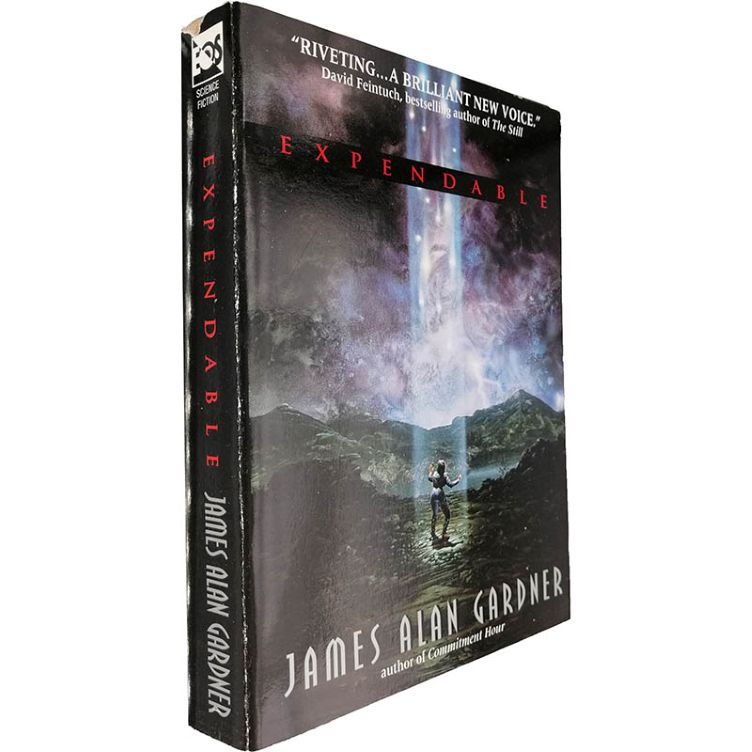
Guest Post: SF Writer Lisa Timpf Reviews James Alan Gardner’s Expendable

I’m happy to present our very first guest post here at Life After Gateway.
It’s a book review by SF writer Lisa Timpf (Cats and Dogs in Space, 2025; In Days to Come, 2022). Lisa is reviewing James Alan Gardner’s Expendable; her review is below, followed by her bio, website, and socials. Thanks to Lisa Timpf for contributing!
— Timothy


———
I stumbled across James Alan Gardner’s 1997 novel Expendable while reading Robert Runté’s review of Finnian Burnett’s Redshirts Sometimes Survive on the Ottawa Review of Books. At the end of the review, Runté notes,
“If . . . you’re interested in an actual SF novel that actually is about redshirts sometimes surviving, may I recommend James Alan Gardner’s Expendable. It’s not Trek, but it is brilliant space opera with a unique Canadian sensibility.”
Runté’s recommendation appealed to me for three reasons. First, Gardner and I both hail from Simcoe, Ontario, so I feel some home-town loyalty. Second, I’d previously read and enjoyed one of Gardner’s short stories, so I figured I’d give one of his novels a try. And third, I’ve been intrigued with different takes on the “redshirts” trope since reading John Scalzi’s Redshirts.

“Redshirts,” for those who aren’t familiar with the term, refer to the “expendable” minor characters, often wearing red uniform tops, that would die during Star Trek episodes. I was interested to see how Gardner would riff on this theme.

Expendable follows the adventures of Festina Ramos, who is an Explorer. In the Technocracy, crime rates are low, there are few violent deaths, and even accident victims can usually be saved due to advanced medical know-how. But on unexplored planets, risks are high and medical facilities are not readily available. Somebody needs to be the first to land, and that job is assigned to the Explorers.
As Festina puts it early in the book,
“In a society where people expect to ease comfortably out of this world at a ripe old age, the thought of anyone being killed in the prime of life is deeply disturbing.”
The Admiralty discovered a long time ago that physically attractive crewmates are particularly mourned. On the other hand,
“if the victim was not so popular, not so well-liked, and above all, ugly…well, bad things happen, but we all have to carry on.”
Based on this philosophy, Explorers are selected based on a combination of intelligence and the possession of some sort of visible or invisible condition that makes them seem unappealing to others.
Festina, for example, was born with a “lurid port-wine birthmark” that covers the right side of her face. Her Explorer partner Yarrun Derigha has an under-developed jaw. Other Explorers encountered in the novel have habits like blinking too often, or physical features like oversized ears.
The twist is that medical science has advanced sufficiently to treat any and all of these conditions. If a potential recruit is tested and lacks the strength of will and intelligence to be a good Explorer, “the full power of modern medicine would be unleashed to correct every impediment.” But if they’re smart and capable, they’re left as-is and trained to be Explorers.
Understandably, this notion of being disposable creates a sense of resentment among the Explorers. This manifests itself in different ways among different characters in Expendable. At the same time, Explorers like Festina take pride in their job and their capabilities, doing their best to carry out their missions.
Expendable is the first novel in Gardner’s League of Peoples series. The League controls who gets the privilege of flitting around the galaxy, and requires that everyone adhere to a rule against killing sentient beings. If someone wilfully kills a sentient being, they are deemed non-sentient and there’s a severe price to pay. It’s not easy to hide misdeeds. The League has some omnipotently powerful entities who seem to have eyes and ears everywhere, like an intergalactic Santa. Humans have to be on their toes, because if their actions show them to be unworthy of space, they will be grounded planet-side.
When Festina and Yarrun are assigned to accompany an admiral named Chee down to the surface of Melaquin, Ramos fears it’s a death sentence. Melaquin is where the Admiralty disposes of their “problems,” like renegade Admirals, and there have been no instances of Explorers returning to tell the tale after being sent to Melaquin as escorts for these individuals. In fact, transmissions from the planet’s surface always cut out a short time after the Explorers and those they are accompanying land on Melaquin.
The whole mythos around Melaquin is part of the book’s intrigue, and shows how the Admiralty, Festina’s employers, try to get around the League of Peoples’ proscription. Because nobody aboard the ship really knows what happens when Explorers and those they are escorting are sent to Melaquin—given that transmissions cut out—it’s possible to plead ignorance. After all, there’s no evidence that the landing party is actually dead, but on the other hand, there’s good cause not to risk sending someone else down after them. That is, until there’s another problem person to get rid of.
When Ramos lands on Melaquin, she discovers there is far more to the planet than she imagined. Through her encounters with the planet’s existing people—a race of glass-bodied entities, many of whom have consigned themselves to resting in limbo rather than living—Ramos learns more about Melaquin’s back story. There are plenty of plot twists and turns to keep the reader engaged.
While the book is divided into sections, each given a one- or two-word title that addresses the key action, events, or mood, within each section the story is told as short scenes introduced with subheadings. This makes the story feel more vivid. Within these short scenes, some new twist, insight, or complication is introduced.
Though I’ve read a fair bit of science fiction over the years, I’d never encountered Gardner’s League of Peoples series. Though Expendable was published in 1997, it holds its appeal almost thirty years later. Funny and thought-provoking, Expendable is still a good read, and I’m glad for Runté’s suggestion to check it out.
— Guest post at Life After Gateway by Lisa Timpf, 28 May 2026
Lisa Timpf Biography

Ontario resident Lisa Timpf writes poetry, book reviews, short stories, and creative nonfiction. Her speculative poetry collections Cats and Dogs in Space (2025) and In Days to Come (2022) are available from Hiraeth Publishing in print and electronic formats. Lisa is a member of SF Canada and the Science Fiction and Fantasy Poetry Association. You can find out more about her writing projects at http://lisatimpf.blogspot.com/. Lisa is also on Bluesky, @lisatimpf.bsky.social
Bluesky: lisatimpf.bsky.social
Facebook: https://www.facebook.com/lisa.timpf.author
Web site: https://lisatimpf.blogspot.com/
———

———
Follow TSJ on Facebook.
Follow TSJ on X.
Follow TSJ on Instagram.
Follow TSJ’s Blog Life After Gateway, featuring one carefully curated news item from the world of Science Fiction, Mystery, Thriller, Horror, and Suspense each day. Enter your email in the “Subscribe to Blog via Email” widget on the right.
———
———
A Blanket of Steel by Timothy S. Johnston and from Fitzhenry & Whiteside, LTD. is the recipient of the 2024 GLOBAL Thriller Award GRAND PRIZE and the 2024 CYGNUS Award First in Category.


— Timothy S. Johnston, 28 May 2026